What We’re Reading

Standard

There’s something about the hot weather that makes me want to pick up a book or three. Maybe it’s that leftover feeling from childhood that summer will last forever, that there’s time enough for everything, even reading for pleasure.

So at the last NJNA chapter meeting I asked some of our brilliant, talented NJNA members for their summer reading “picks.” They were generous enough to share the following recommendations.

If you have favorite books to share, let us all know by commenting below.

Happy reading!  Mally Becker

  • Carol King is reading Robert Crais, who writes thrillers. “You never guess ‘who did it,’” she said. She also recommends Michael Connolly’s books, whih feature Harry Bosch.
  • Sue Chadwick gives a “thumbs up” to the “Goddesses Anonymous” series by Emilie Richards. These novels take place in Asheville, NC, and Sue likes that each story features women helping other women.
  • Carol Friedman recently read The Lady in Gold by Anne-Marie O’Connor, the true story that inspired the film “The Woman in Gold.” Carol then visited the painting at the center of the story, Gustav Klimt’s “Portrait of Adele Bloch-Bauer,” which hangs in the Neue Galerie in New York City.
  • Heidi Kelleher enjoyed A Man Called Ove by Fredrick Bachman. People Magazine called this book: “A charming debut …You’ll laugh, you’ll cry, you’ll feel new sympathy for the curmudgeons in your life.” Heidi also recommends All Over But the Shoutin,’ a memoir about growing up dirt-poor in Alabama by Rick Bragg, a Pulitzer-Prize-winning reporter.
  • Nancy Brighton is in the middle of Havisham, by Ronald Frame. This prequel to Great Expectations tells the story of how and why Miss Havisham came to stalk the halls of her mansion in the tattered wedding dress she wore in Charles Dickens’ masterpiece.
  • Jill Williams enjoys the bibliophile mysteries by Kate Carlisle, featuring bookbinder Brooklyn Wainwright. She also recommends: the Gregor Demarkian series by Jane Haddam; Jeffrey Sigar’s mysteries, which are set in Greece; L.B. Hathaway’s Posie Parker series spanning the 1920s, Joseph Kanon’s thrillers, which are set primarily in post-WWII Europe; and, Susan Elia MacNeal’s spectacular Maggie Hope series, which begins with Churchill’s Secretary.
  • Cathryn Curia recommends The Bregdan Chronicles, a sprawling series of historical fiction novels that take place in the shadow of the Civil War. She also enjoys Adriana Trigiani’s stories, which include The Shoemaker’s Wife, and Jeffrey Archer’s historical family drama, The Clifton Chronicles.
  • Diane Burgess also enjoys Jeffrey Archer’s novels and those by Robert Galbraith (a.k.a. J.K. Rowling) featuring British detective Cormoran Strike.
  • Nancy Winterbauer likes Jacqueline Winspear’s series of mysteries featuring psychologist and investigator Maisie Dobbs, which takes place in Great Britain between WWI and WWII.


July 2016 SOTM

Standard

Hi Everyone —

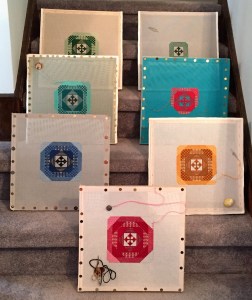
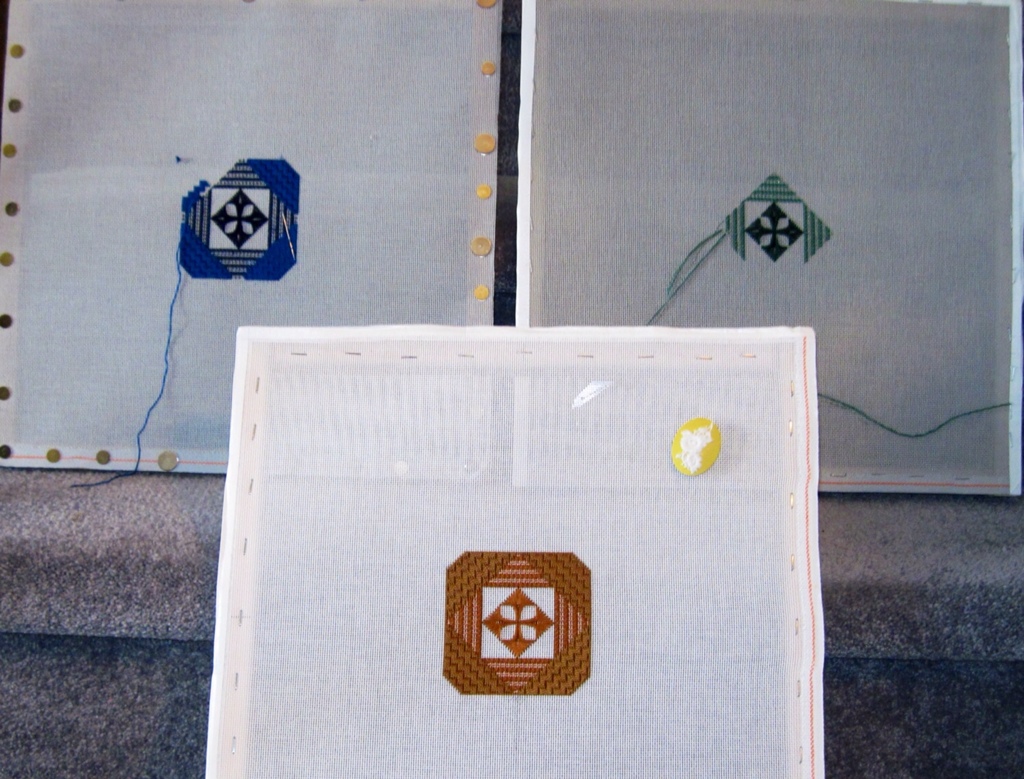
Just wanted you to see today’s progress on the ANG SOTM project designed by Susan Hoekstra!

IMG_0027

Aren’t these colors wonderful?

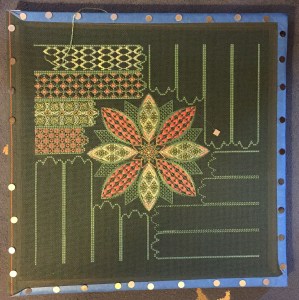
IMG_0032

Rosie is working on the 2015 SOTM — Razzle Dazzle by Ann Strite-Kurz.

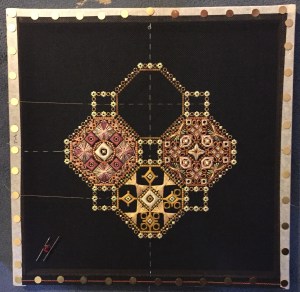
IMG_0030

Dee is working on the 2014 SOTM — A Different View by Kurdy Biggs!

Enjoy!

Cheers, Rosie

Metropolitan Region, EGA, “Stitched Art” exhibit

Standard

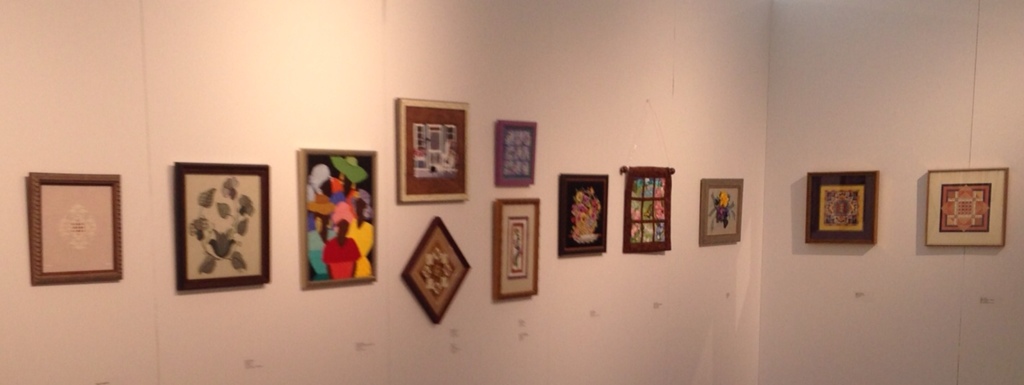
“Stitched Art” is the exhibit being held at the gallery in Annunciation Hall at the College of St. Elizabeth in Convent Station, NJ, from Saturday, June 18 through the following Sunday, June 26, from 10-4 daily. The exhibit is open on Thursday until 8:00 p.m. and will close the last Sunday at 3:00. The college has easy access off both I287 and highway 24. The college address is 2 Convent Road, Morristown, NJ. You can find directions to the college on their website under the heading “About”. When you arrive on the campus, you will see “Event” signs directing you to the building.

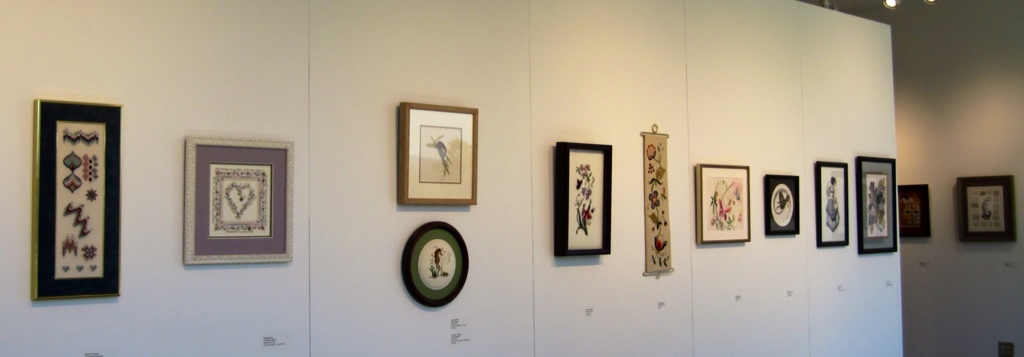
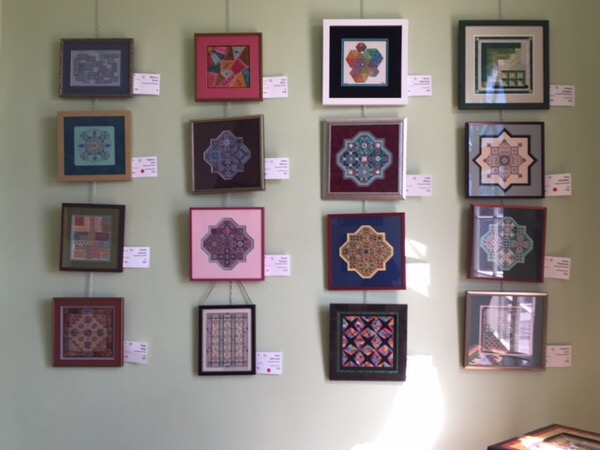
I was there this morning to see the display of almost 70 pieces of all sorts of needlework, all exquisitely done. You will see that some are originals, some adaptations and some give you the name and designer of the piece as well as the stitcher’s name. The gallery is well lit with outside light as well as spotlights highlighting the pieces. Here is an overview of two walls of the exhibit. The admission is free.


For those of you who knit or do any form of hand work, there are table set up in the large, well lit hall outside the gallery (with outlets for your lights if it s a dull day) if you would like to make a day of it. Come, see the exhibit, stitch for awhile and go out to lunch. We have both Discovery maps showing Morristown, Madison and Chatham, as well as a listing of some local restaurants.

Hope to see you there in the coming week. It is well worth a visit!


Finding a Good Framer

Standard

A long time ago on one of my visits to CA, I discovered a wonderful shop in Alameda, called Needle in a Haystack.  I remember looking at a number of wonderful charts for counted work, as well as drooling over a number of lovely threads.  Oh yes, I did end up buying a Stella lamp.  There is a lot there for the cross stitcher as well.  I’ve also dealt with the online store and have always received great service.  In addition, they send out a monthly newsletter that is quite informative.  With the owner, Cathe’s permission, I am reprinting an article from this month’s newsletter.  Given that the frame shop in Mendham is closing, I thought this information might prove to be timely.  Happy reading!

How To Find A Good Needlework Framer

Jan at Bay Stations Accents has been in school in Scotland for the past year and when she comes back this year I don’t expect that she’ll continue her framing business. Given she’s be doing my personal framing for more than 30 years I’ll be very sad, as I’m sure many of you who are local are. On my to-do list is to find a new local framer to recommend but it’s way down my priority list at the moment. So instead I thought I’d write about how to find a good needlework framer. I’m not going to cover questions about their sense of color or style since those are general framing questions.


Even if you find someone who has been doing needlework framing I think you should always ask questions and if possible, see some of their framed needlework. I am a very picky customer when it comes to framing so it has to been completely square or I’m an unhappy camper. Jan’s attention to detail in this regard was very important to me. So, what to ask a potential framer?

What is the base they attach the needlework to? What are the other materials used?


I prefer acid-free materials when at all possible, especially what the fabric is being wrapped around. I do my own mounting these days and I use acid-free mat board glued/taped to acid-free foam core. I almost always use a colored mat under my work since white isn’t always the best option. Typically I use a dark green or dark blue, especially on pieces with open work. Any mat on the top of the work is also acid-free. And if I use glass, it’s Museum quality. Acid-free reduces any possibility of things leaching into your fabric over time. Sometimes I use a batting to give the underside of the needlework some depth (in place of the mat board under it). For that I use a good quality polyester or cotton batting. You can always ask a quilt shop what’s the best to buy if you want something more archival quality. Many framers won’t have used batting so might not be familiar with it – so it’s a conversation to have with them.


How do they attach the needlework to the base?


If they mention sticky backed board, run away, very, very fast. Granted it has it uses for craft projects, even for things like tiny ornaments, but if you’re spending the money on framing, do not let sticky backed board get near your work. Not only is it not good for the stitching to come in contact with it, over time it will lose its hold and the project will buckle. When we were first open 18+ years ago one of our now long time customers loaned us her Dutch Beauty sampler to hang as she didn’t have room. After a year we noticed the fabric was sagging in the frame so we had Jan take it apart to fix it. She came over livid that the framer had stretched this masterpiece of a sampler onto sticky backed board. Getting it apart was a job but one we were happy to pay her to do to thank the customer for the loan (thanks Anna-Marie!). My point is, sticky backing has a very limited use but not for good quality needlework.


My preferred method of attaching work to the foam core is stainless steel pins and I learned this from Jan. Stainless Steel doesn’t rust so you can safely leave it in the side of the work (they go through the fabric into the side of foam core). Very few pins are made from stainless steel, most are nickel plated. I use Dritz Silk Pins or Bohin Stainless Steel pins, we sell both but you can find the Dritz ones in many fabric stores. Even with the pins in the side I either lightly lace or use acid-free tape to hold the back fabric in place. If you use just lacing to hold the work, which you can do, it many times puckers the fabric and over time can do a serious number on the fabric due to the tension on it. So I like the stainless steel pin method for a permanent hold that won’t pucker. If they want to use tape alone it won’t hold over time as the glue will eventually lose its hold, so it needs a more permanent method.


How do they align the project?


For my own work I put basting lines in my fabric where the edge of foam core would be, so I know I’ve stretched it straight onto the foam core/mat board backing. I just use sewing thread in a color I can see and can easily remove (don’t use floss since it can leave a residue when you pull it out). I rarely do this with needlepoint since typically I’m wrapping it at the edge of the stitching anyway. But you want to make sure the framer understands the importance of getting it completely square. You don’t want to get it back and find it’s off 2 threads from top to bottom, unless that doesn’t bother you – as you can guess, it bothers me :-).


If they use glass, do they use spacers and what type of glass?


I rarely use glass personally but there are times when it’s the right option. Make sure that they are using spacers so that the glass does not sit directly on the stitching. If you have a mat between the stitching and the glass you might not need spacers unless the stitching is very tall and would touch the underside of the glass. For heirloom quality work, use Museum glass, which is very clear. It’s more expensive but well worth it for those special pieces.


Do they block your work if it needs it?


It is very rare that a framer will block needlework since it involves a whole other skill set. But ask them if they do blocking and find out more about how they do that if they indicate they offer that service. Since most won’t, you might need to send it to a finishing service to have it blocked before taking it to the framer. For individual pieces that look like they need blocking, talk to the framer first to see if they think blocking is required. If it’s slightly out of shape it might not since the mounting base will help it keeps its shape. However if it’s seriously out of square blocking would likely be required.


How do they store your project?


While you might not think this is important, I believe you also want to know how your work is being stored before it’s being framed. If it’s crumpled up in some corner, perhaps you need another framer. If they wrap it up in tissue to keep wrinkles away and store it in a clean storage container, you might have more confidence in the rest of their work as well.


What do they charge and what is the turn around time?


I didn’t start with this since I think the other questions are more important to flesh out first. Custom framing is never inexpensive. And just because a framer charges a lot does not mean they will do a good job with needlework. So once you’ve determined that they might be a good framer for your projects, then is the time to find out the price of the work. Most framers will charge for mounting the work in addition to the actual framing. It’s the mounting work that’s really the hard part for needlework so don’t be shocked at seeing an extra charge for that. They might be able to do quick jobs or they might take a couple of months, but finding that out ahead of time is also useful.

If you feel comfortable with the framer and are not able to see samples of their needlework framing, take them something you aren’t as worried about to do as a first one. And if they are not willing to listen to constructive criticism, find someone else. This needs to be a two way street for awhile until you’re confident in them.


Another option is to learn how to do the mounting work yourself and then only have the framer do the frame and putting it all together. This is in fact what I do these days (granted I’ve not had much to frame of late since I’ve not finished as many projects as I’d like). I do private lessons on this occasionally for people who want to learn. Hopefully when my life settles down a bit I’ll do a video on this part.


For those of you who don’t mind sending your work away to get framed I can recommend Deb at Stitchville USA in Minneapolis, MN and Sandy at Attic Needlework in Mesa, AZ. Both do really great needlework framing work. Many other needlework shops around the country have their own framing department so that’s another avenue to check out.


I hope you find this helpful information for finding a good framer for your work. Don’t be afraid to ask questions – your needlework projects deserve the best!


Cathe Ray –

Needle In A Haystack

510-522-0404 phone

877-HAYSTAC (877-429-7822) toll-free

510-522-3692 fax

2433 Mariner Sq. Loop, STE 102

Alameda, CA 94501

haystack@needlestack.com

http://www.needlestack.com
Loon Tunes Day 2

Standard

I know I’m a bit late with this post, but did want to share!

Day 2 of our Loon Tunes class was interesting in the way Ann Strite-Kurz approached it. She spent the first part of the morning explaining everything we had not yet worked in and then set us free to work on whatever section we wanted. She encouraged us to work on the water areas as they require compensation around the circles. The one section was easy but the bottom one is a bit of a challenge.

Ann also set aside time where she could demonstrate the spider stitch to small groups of us so we could see what she was doing. Likewise she demonstrated the buttonhole stitch covering a metal ring which will be applied for the eye. This was far better in both cases for me than having her demonstrate to the whole class at once or to provide charts only to do this. You can see I got the idea but need some more practice to improve my spiders.

One class member had gotten the blue canvas but the grey threads. It gave a softer view to the background. I decided to try a combination of the blue and grey threads to liven up my background but realized I needed to put in more of the Loon before deciding. At least it’s an option to play with!

Meanwhile, we did lunch once again at The Local Baker and Café. Their food is outstanding and their cookies are to die for! I ordered a sandwich to take on the plane and they wrapped it to keep it fresh.

I thoroughly enjoyed this class and am eager to have time to do more work on my Loon. Even though it was a pilot, the material was very well done and I had few questions or suggestions. It was great fun meeting Pat, Ann, and several other members of the San Bernadino ANG chapter.

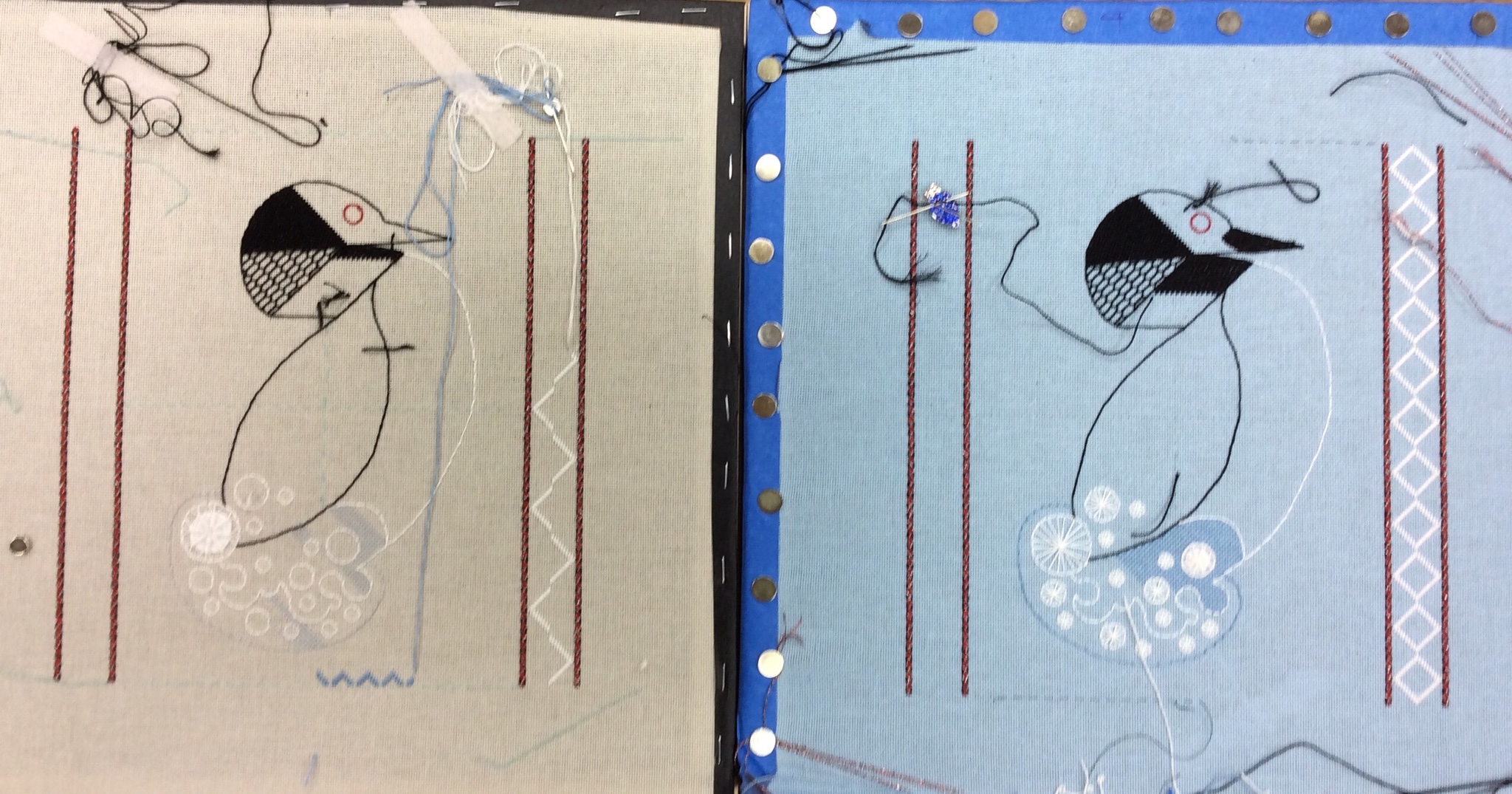
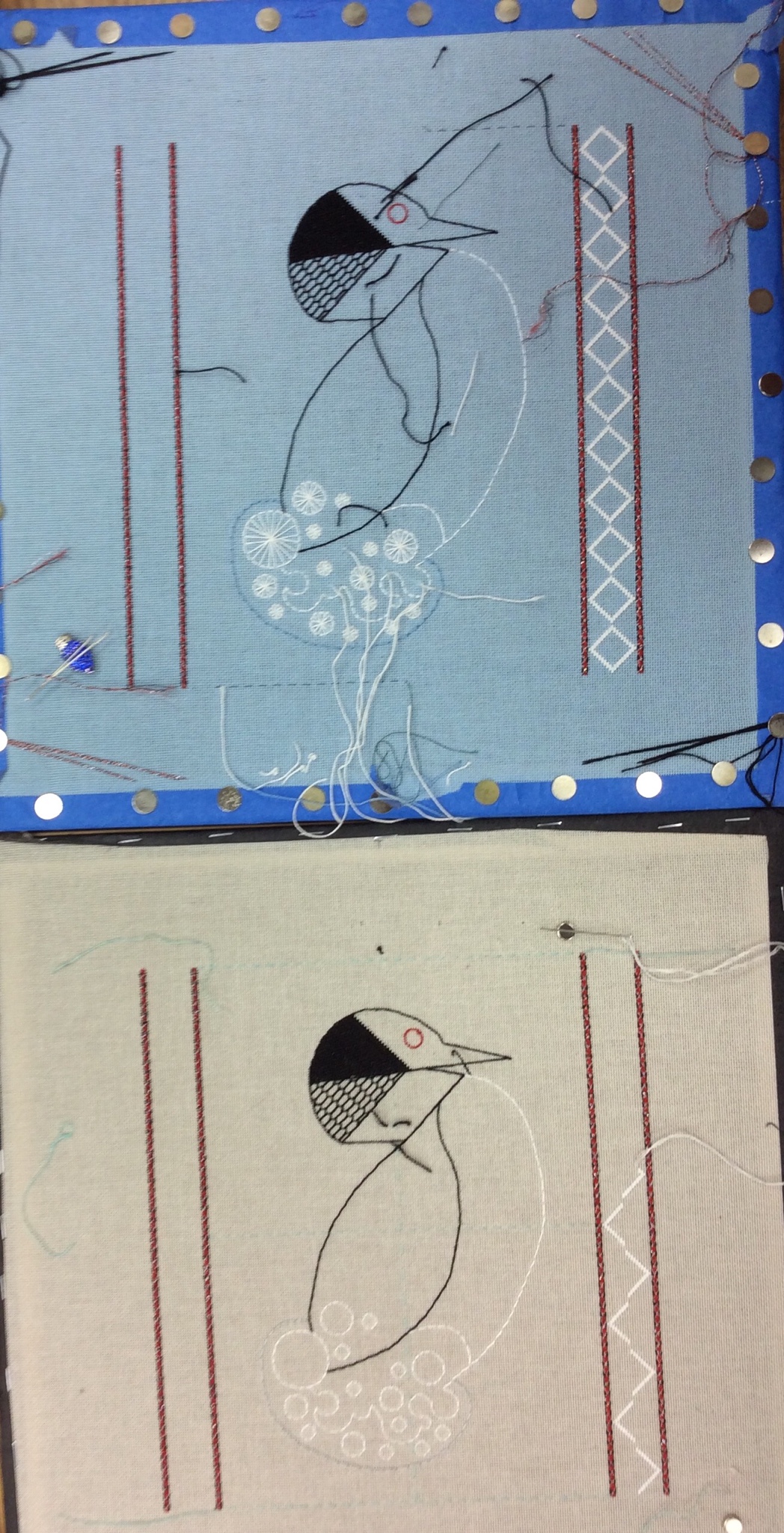
Here’s my and Rosie’s progress at the end of class:


Day One of Loon Tunes

Standard

Rosie and I are taking the pilot class for Loon Tunes by Ann Strite-Kurz. The class is sponsored by the San Bernadino chapter of ANG so it’s been great fun to meet people we had only communicated with via email before. The class is held in a local bank’s conference room which has an outside entrance. The room is large and bright, which makes for the perfect stitching environment.

We had done some pre-work outlining the loon and the side borders. Day One, we did the two upper left sections of the loon’s head and neck. Ann used Blackwork to simulate the stripes of the lower left section of the loon’s head. Ann provided the start for the Blackwork and encouraged us to use that to learn how to do the rest. The upper left section is a combination of pearl cotton and Kreinik which gives a wet look to the loon’s head.

I’ve learned a lot about carrying threads in open canvas and keeping the threads straight in the border diamonds.

Rosie and I went to dinner at Kishi’s, a Japanese steakhouse, with Ann, Pat C from SBANG, and Kathy, another student in the class from out by the coast. It was great fun with a lot of interesting discussion.

Ann is an interesting teacher who provides lots of background commentary, knowledge of other needlework teachers, and detailed information on the piece. I am thoroughly enjoying this piece.

Here’s our progress after Day One. Mine is the gray, Rosie’s is the blue. We’re eager to see the comparison of the different color ways once completed.


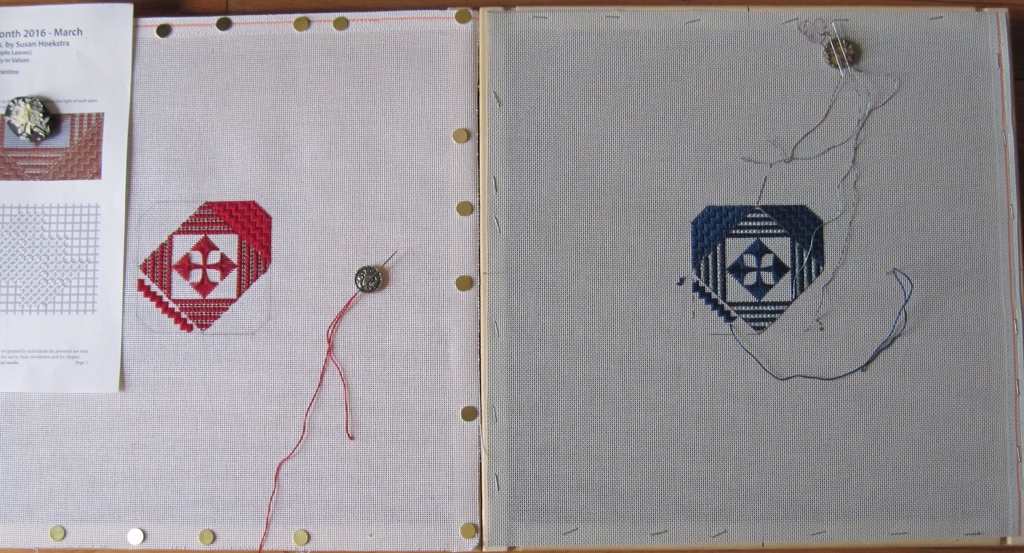
SOTM, March, 2016

Standard

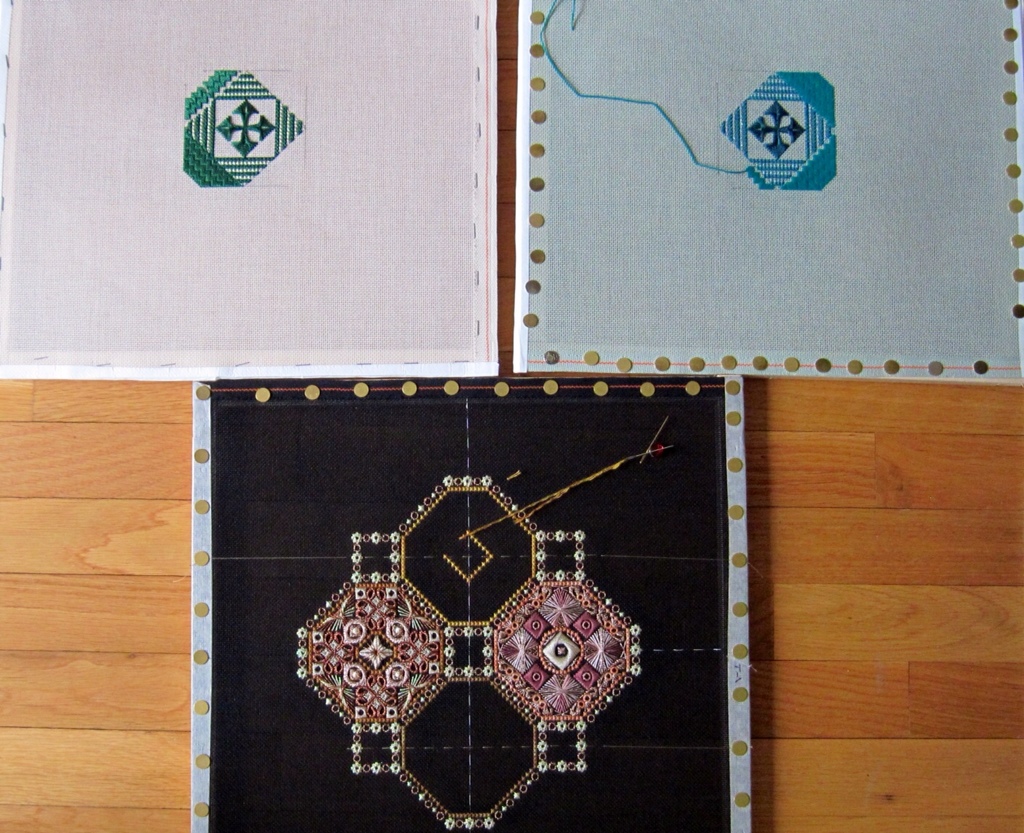
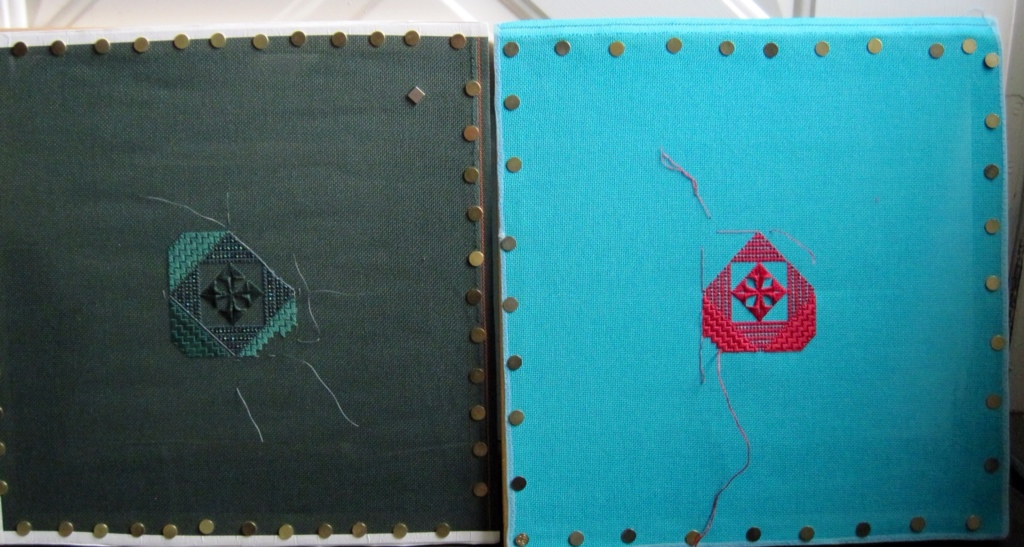
We are in our third month of the ANG SOTM designed by Susan Hoekstra. So this is the second round about the center. The stitch this month is the Byzantine which you will see in a variety of threads in the photos. Since you may begin wherever you have a long diagonal run of complete stitches, you will see a variety of appearances. Some of us changed from under compensating to over compensating, and the compensating will be in different areas but everything works. Linda M. even managed to complete the section before the day ended! As it was Jill’s birthday (what better way to spend a birthday than stitching with friends?), we had sponge cake with strawberries for dessert. Let’s see if I can get the pieces labelled correctly!

Upper left, Joan, S. upper right , Sue C. Bottom,, Dee L. completed the second medallion from 2014!

Nancy W. on the left and Mally B. on the right. As a first timer, Mally is really going to town!


Robin M. upper left and Mary D. upper right with Linda M.’s completed round!

Jill W. on the left, the green on the dark green canvas does not show up well, but Tina F.’s red/pink shows up well in the turquoise canvas!

Next month we will be stitching at NeedleFest on our SOTM and Susan H. will be able to see our work and colors!


Woodlawn!

Standard

I am very excited that for the first time ever I have two pieces of my work entered in an exhibition. I was encouraged by my fellow ANG chapter members to submit an entry to the Woodlawn Needlework Exhibition and Sale. So I dove in and sent two pieces down to the exhibit with Linda M and Mr. M.

There was no doubt I would go and look at all the needlework since I have a good friend who lives in the area. Of course the only time our schedules aligned, was for opening day. So off I went. It was a beautiful, but blustery day and I had the best time ever!

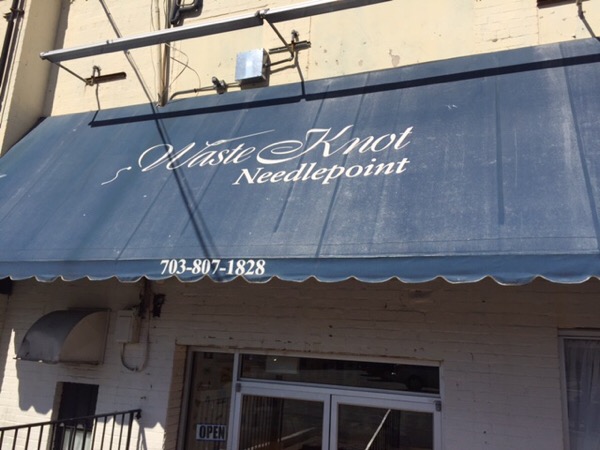
Upon my arrival the day before, I met with the “other” Barbara L. for lunch and a visit to Waste Knot in Arlington. We had fun getting to know each other better and of course shopping. The shop was quite nice. They had some threads I hadn’t seen before. It was quite funny that our respective husbands reminded us not to mix up the credit cards. 😀

The next day, I set off for Woodlawn. As one pulls up the drive, the mansion looks quite majestic.

Of course once I got inside, there was the usual confusion in regard to the “other” Barbara L. There was only one Barbara L listed in the program, so I had to explain there were two of us when I checked in. That Barbara lives near Woodlawn, so she has been involved with the exhibit for many years.

So, now I was inside the exhibit and there was such eye candy! The work across all media was really breathtaking. I saw cross stitch pictures that looked like photographs and stump work that had incredible detail. The gold work was amazing. I did find amusement that the morning guides were from the local garden club and I did a bit more explaining to them than the other way around. Yet, they were quite charming and lovely to chat with. They did explain some interesting things about one or two of the pieces in each room. One thing they did explain was that the ribbons had not yet arrived. So, on the name tags, the entries that won ribbons had different colored dots, indicating their place. Of course I couldn’t tell what the different categories were. I also over heard that people who had entries could have the guides get a docent and then they could take a photograph of their own entry.

You know I was really there to see the needlepoint, dot or not. I loved it! There is a lot of talent out there. Finally, I hit the dining room and there was my hydrangea piece hanging on the wall. I was excited!

Now, I started to look for the chapter display in earnest. It was no where to be found on the ground floor. I went upstairs and I still didn’t see them. Finally I went into a bright sunny room that had no furniture, but a whole uninterrupted wall for display. There they were! I also saw my second piece, which was a Tony geometric counted piece. However, I quickly looked away because I noticed Mary D’s piece ( I believe it is her Frankie piece) had a red dot on it! I was so excited for her. I quickly tagged the guide to find out what she had won and it is a second place. Sorry that I don’t know the category. Congratulations Mary! At any rate, I began to look at the wall in earnest and it was then that I noticed that my name tag had a red dot also. I kept looking back to make sure my eyes weren’t playing tricks on me. What great positive reinforcement for a first time exhibitor! I also noted with amusement that the “other” Barbara L. had a piece on the same wall. Thankfully, the two pieces were labeled correctly. I took one last look around and then I was off to In Stitches.

I had a very nice visit there and bought a few notions. I found a reproduction magnet with an embroiderer on it.

Keeping with the historic theme, I decided to visit Washington’s mansion at Mt Vernon. I think the last time I was there, I was about ten. Needless to say, the park service has made vast improvements. No photographs allowed inside, but here is a panoramic view of the Potomac.

For you knitting and weaving enthusiasts, here are some photos of the spinning room, which is an outer building.

Of course no day would be complete for me without a stop at a local yarn shop. I went to Fibre Space in Old Town Alexandria. What luscious yarn, some of which is locally dyed. However, I was able to stay on my yarn diet by focusing more on notions. They had a new needle that I had never seen before. It looks like a boomerang and is used in place of double point needles. Really interesting.

So my fun day came to an end. I felt really happy and satisfied. I encourage all of you, if you can, to go south and take a visit to Woodlawn.

Mid Winter Cape Cod

Standard

One might wonder why anyone would choose to go to Cape Cod in the middle of winter. Well for the past several years that is exactly what I have done. My dear friend Susan, with whom I have been friendly for the past thirty years, has a home there and she graciously invites me. She is also a fiber enthusiast. Though she only does limited needlepoint, she is more than adept at so many other needle arts. When we load the car, it looks as if we are moving. The suitcases take up very little room. The rest is all needle art related. There is lots of yarn for knitting, her paints, weaving and quilting and of corse my needlepoint paraphanalia, stand and all.

We arrived there this year on Super Bowl Sunday. As we were rushing to buy groceries before the store closed for the big game, we discovered that the anticipated precipitation for the next day had been upgraded to a blizzard. What fun for two people who wanted to pursue their passions. So we had a glorious time since we did not lose any power.

The next day we had enough cabin fever to want to go out. One of the things we did was go to a Cape Cod institution. This of course had to do with needlepoint. We went to Town Ho Needleworks in Brewster.. This is a very interesting place. One has to climb a fairly steep flight of steps to get inside the shop. If one can see past the “interesting” filing and set up in the shop, there are some real jewels. There are charts for counted work from designers who are no longer designing or no longer with us. The owner of the shop is a huge Maggie fan. I saw many canvases I had never seen “live”before. There is a nice selection of threads and good quality notions. The owner told us that he tried to retire five years ago, but his students wouldn’t let him. So his Cape Cod institution goes on. If you go to the Cape, his shop is worth a visit.

There is one other needlepoint shop on the Cape which I did not get to visit this time. It’s a bit out of the way from where we were staying. Osterville Needlepoint Shop is under new ownership, so I don’t wish to really comment on what I saw when I was there last year.

I drove home by myself since Susan’s husband was joining her at the Cape. Of course I had to detour to do needlepoint shop hopping. I decided to go to Larchmont to see Stitch by Stitch. This is a lovely shop full of beautiful canvases. At that time they had a Labors of Live trunk show. The owner was so accommodating and went out of her way to help me find a good small battery run light for my airplane travels. There is also a wall of notions.
I highly recommend a stop there as well

So, a mid winter visit to the Cape is not so strange after all.